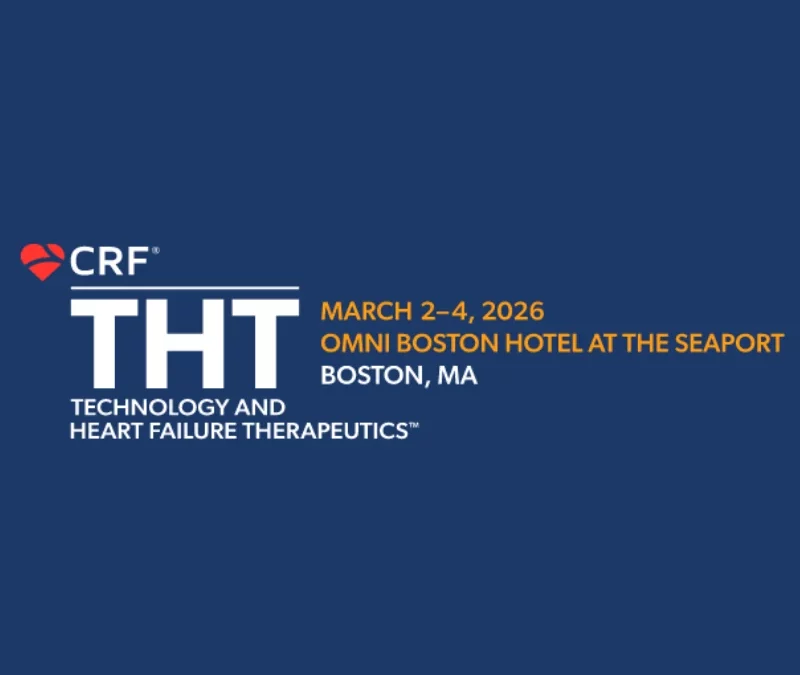
CardiaMetrics is proud to announce that our first scientific results will be presented at Technology and Heart Failure Therapeutics (THT) in Boston (Home Page | THT 2026), one of the world’s leading conferences dedicated to breakthrough technologies in heart failure care.
Our abstract, entitled:
“Cutaneous device and machine learning could estimate pulmonary capillary wedge pressure in patients with heart failure”
has been selected for presentation during:
HF Insight – First-in-Man / Early Feasibility Studies Abstracts Session III
📅 Wednesday, March 4
🕘 9:15 AM – 10:21 AM (ET)
📍 Room: Ensemble C-D | Level 2
🎤 Presentation by Rémi Sabatier at 10:10 AM
A Major Scientific Milestone
This presentation represents the first peer-reviewed scientific outcome from CardiaMetrics to be showcased on an international stage.
Being selected for THT, a best-in-class conference gathering global leaders in cardiovascular innovation, is a strong validation of our technology and scientific approach. It reflects growing recognition from the clinical and research community of our work in reconstructing intracardiac pressures using machine learning.
Advancing Low-Invasive Hemodynamic Monitoring
Our study demonstrates that a low-invasive cutaneous device combined with advanced machine learning algorithms can estimate pulmonary capillary wedge pressure (PCWP), a critical hemodynamic parameter in the management of heart failure patients.
Accurate assessment of intracardiac pressure typically requires invasive procedures or heavily implantable sensors. Our approach aims to provide a scalable, data-driven alternative capable of supporting earlier detection of decompensation and more proactive disease management.
This research represents an important step toward bridging the gap between traditional remote monitoring solutions and low-implantable pressure sensors.
Built on Clinical Research with CHU de Caen
These results stem from the clinical study we initiated in collaboration with CHU de Caen. This early feasibility study laid the foundation for validating our technology.
The data generated through this collaboration enabled the development and validation of our machine learning models for reconstructing intracardiac pressure low-invasively.
Scientific Recognition of Our Machine Learning Approach
The acceptance of our abstract at THT underscores the scientific community’s recognition of our physiology-based machine learning methodology. Reconstructing intracardiac pressure from non-invasive signals represents a significant technological challenge — and a meaningful opportunity to transform heart failure management.
This milestone reflects the dedication of our expanding team, the strength of our clinical partnerships, and the continued trust of our investors and collaborators.
Looking Ahead
Presenting at THT Boston marks the beginning of CardiaMetrics’ international scientific visibility. We look forward to engaging with clinicians, researchers, and industry leaders to further advance innovation in scalable, low-invasive hemodynamic monitoring.
This achievement reinforces our mission: to redefine heart failure care through intelligent, accessible, and clinically validated remote monitoring solutions.