
Our Technology
Engineered for Precision. Designed for Earlier Action.
Our implantable sensing technology combines automatic, daily physiological monitoring with predictive analytics to detect cardiac deterioration earlier and support proactive, personalized care.
One connected system
From daily monitoring to informed clinical action.
Four connected steps bring physiological information from the patient’s home to the care team.

-
Capture cardiac signals
The SCOUT implant is designed to collect daily physiological information automatically.
-
Connect from home
A home gateway links the implant to the data infrastructure through available network connections.
-
Transform data into insight
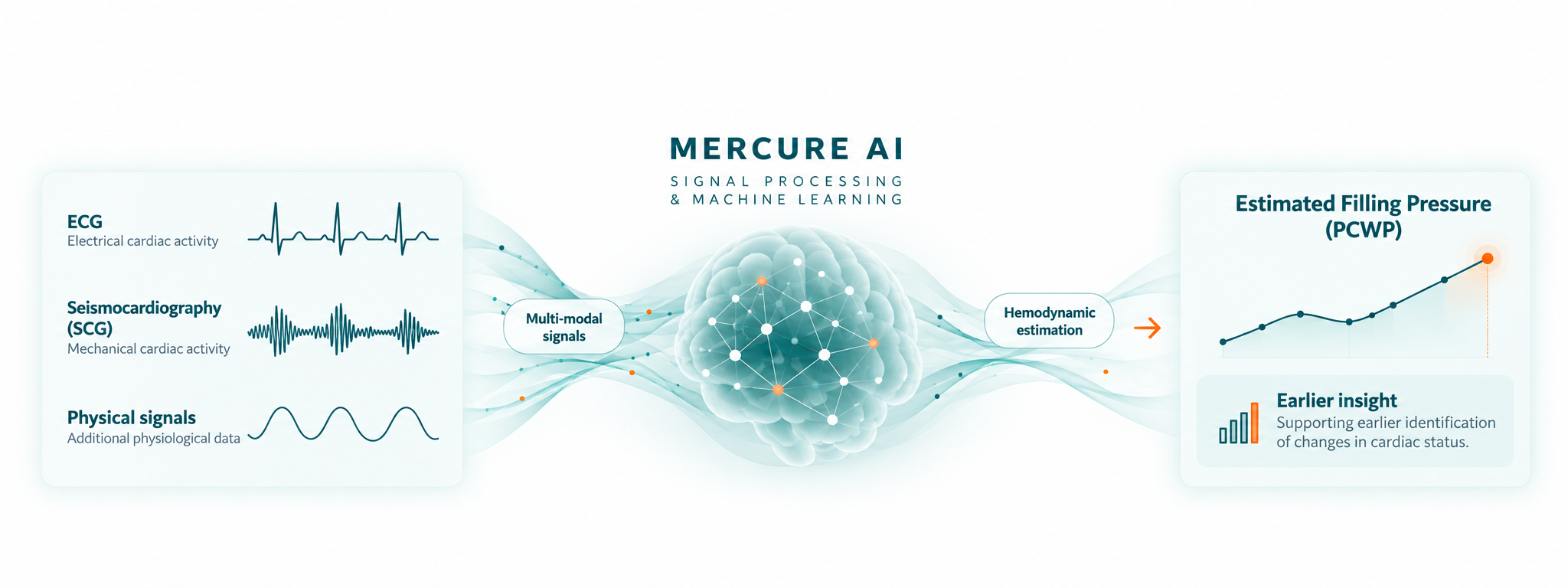
MERCURE analyzes complementary signals to estimate information associated with cardiac filling pressures.
-
Support earlier assessment
Longitudinal information is designed to help care teams assess meaningful changes in cardiac status.
SCOUT implant
Small implant.
Continuous insight.
A compact, multi-sensor subcutaneous implant designed for long-term, automatic cardiac monitoring.
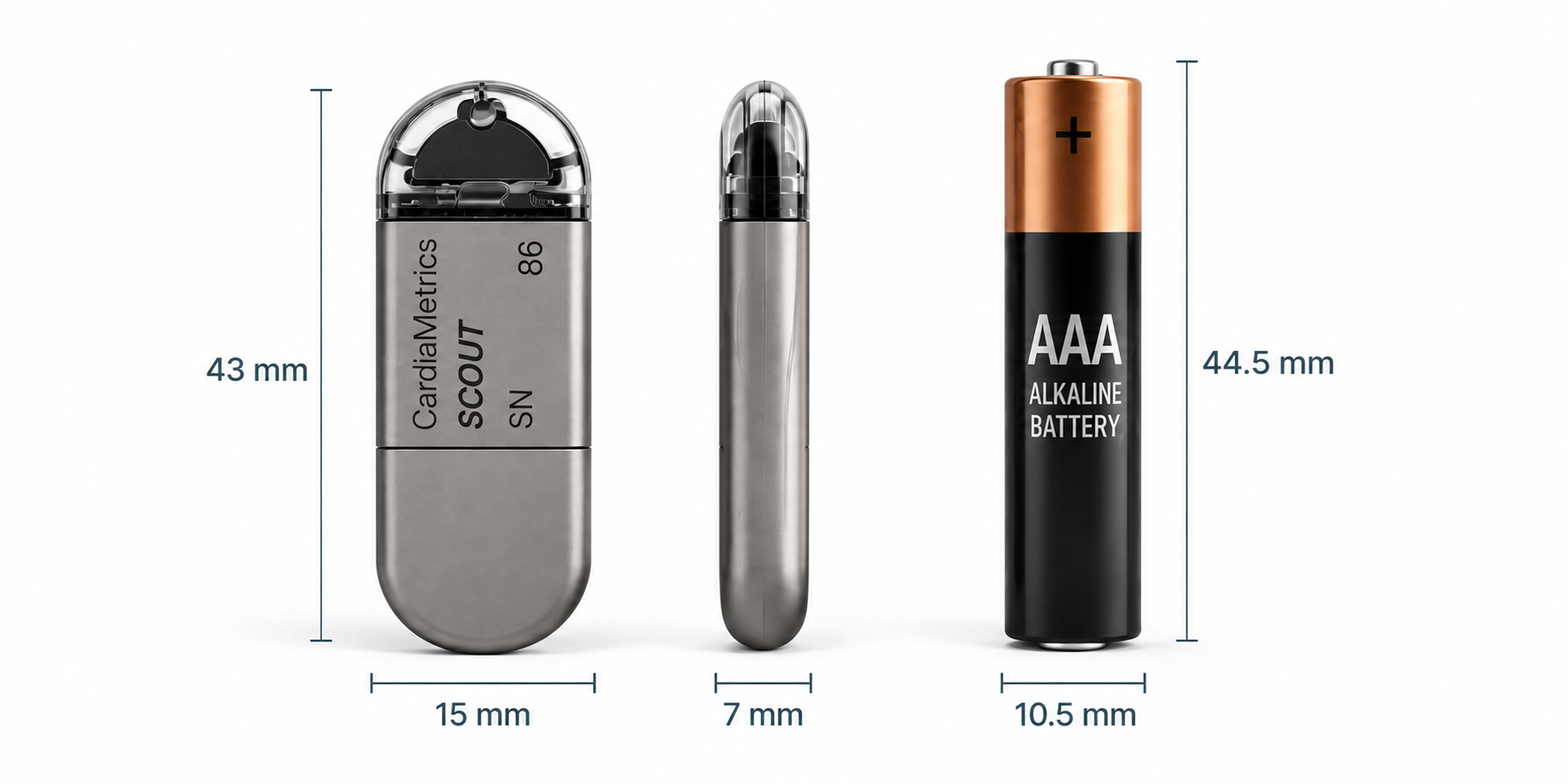
SCOUT combines electrical and mechanical cardiac sensing, long-term power management and wireless communication within a compact, biocompatible titanium enclosure.
- Multi-sensor ECG + 3-axis accelerometry
- Up to 6 years* Targeted battery longevity
- Minimally invasive Subcutaneous, ILR-like form factor
- Automatic monitoring BLE connectivity with HOME Gateway
Explore the engineering
Physiological sensing: SCOUT integrates an ECG sensor and a 3-axis accelerometer to acquire complementary information on cardiac electrical activity, mechanical activity and movement.
Implant architecture: Designed for subcutaneous placement, SCOUT features a biocompatible titanium enclosure with a form factor comparable in length to implantable loop recorders. Its maximum dimensions are 43 × 15 × 7 mm.
Power and longevity: The system targets up to six years of battery operation, subject to validation of the final device configuration and operating conditions.
Automatic connectivity: Bluetooth Low Energy enables communication with the HOME Gateway, supporting a monitoring workflow designed to minimize routine patient interaction.
*Six-year battery life is a development target, not a validated or guaranteed product specification. SCOUT is an investigational technology.
Proprietary technology
From physiological signals to trusted clinical insight.
MERCURE AI is CardiaMetrics' proprietary intelligence platform, designed to combine multi-modal physiological signals with contextual information and machine learning. By filtering and interpreting data in context, MERCURE aims to deliver more reliable, clinically relevant information.
Input
Multi-modal data
Complementary physiological signals and contextual information provide a broader understanding of the patient's cardiac status and measurement conditions.
Intelligence
Context-aware AI
Proprietary algorithms process and filter physiological signals, taking measurement context into account to identify potentially unreliable data and reduce misleading interpretations.
Output
Confidence-informed insight
MERCURE is designed to provide clinically relevant information together with an assessment of data reliability, helping care teams make more informed decisions about patient management.
Technology under clinical development. MERCURE's contextual processing, reliability assessment and clinical utility are subject to ongoing evaluation and validation.
Why hemodynamics matter
Hemodynamic changes can occur before symptoms become apparent.
Changes in cardiac filling pressures can provide important information about evolving heart failure. CardiaMetrics is developing a way to estimate these changes remotely, creating an opportunity for earlier clinical assessment.
Longitudinal monitoring
Estimated cardiac filling pressure
-
Stable
Baseline cardiac status
-
Rising filling pressure
Hemodynamic changes may begin
-
Symptoms
Clinical deterioration becomes apparent
-
Potential hospitalization
Acute care may become necessary
The opportunity
Move from reacting to symptoms toward earlier clinical assessment.
By providing longitudinal information on estimated hemodynamic changes, CardiaMetrics is designed to help care teams identify meaningful changes in cardiac status earlier and support proactive clinical decision-making.
Explore Clinical ValidationConceptual representation of heart failure progression.
Connected monitoring
Seamless connectivity.
Wherever life happens.
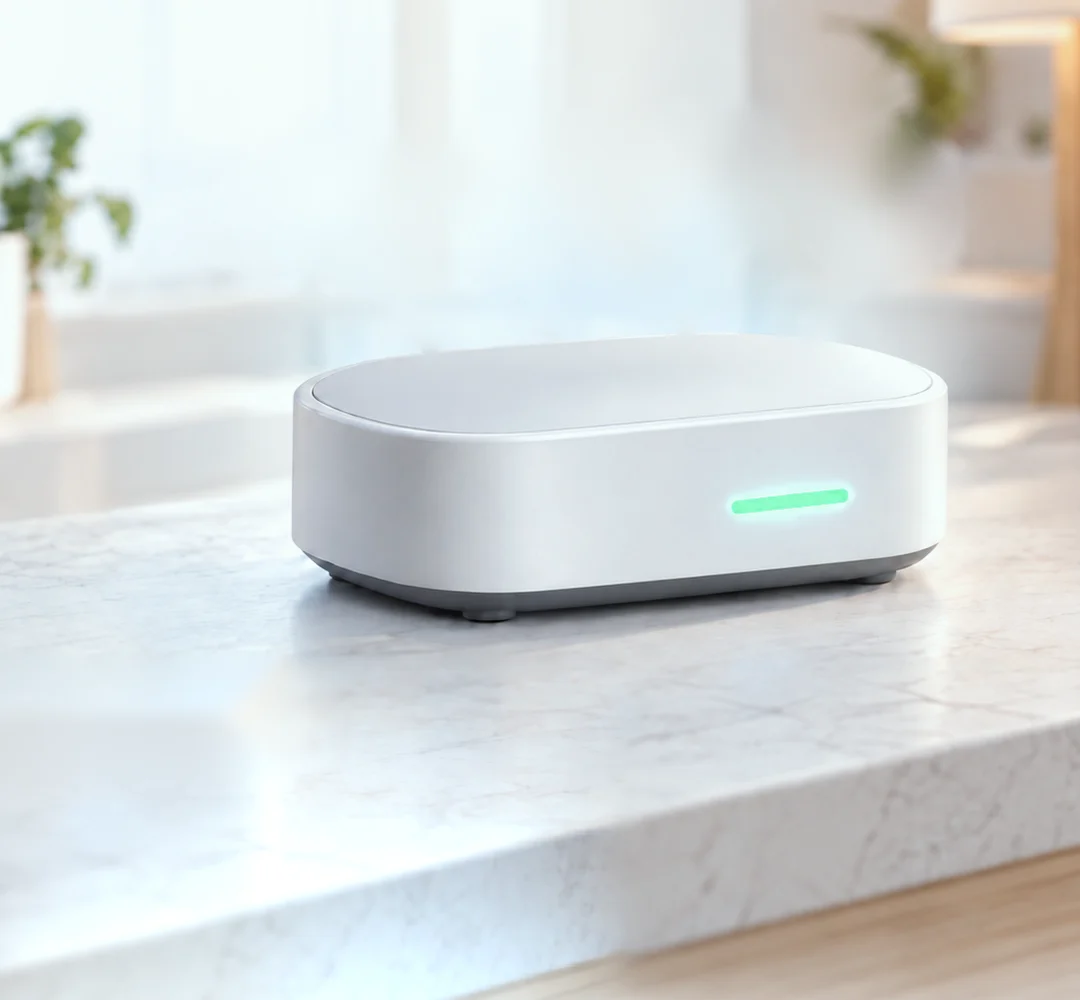
CardiaMetrics is developing flexible gateway solutions to connect SCOUT with the remote monitoring pathway, at home and beyond.
-
Implant link
Communicates with SCOUT using Bluetooth Low Energy.
-
Flexible connectivity
Supports data transfer through available network connectivity.
-
Automatic operation
Designed to transfer monitoring data with minimal routine patient interaction.
-
Secure updates
Designed to support secure software maintenance and updates.
Secure data infrastructure
Built for security.
Designed for regulatory adaptability.
CardiaMetrics is developing a secure, adaptable health-data infrastructure designed to protect sensitive patient information and accommodate the healthcare and data protection requirements of each country in which the system is deployed.
Conceptual architecture illustrating protected physiological data handling and controlled clinical access.
-
Data protection
Designed to support secure transmission, storage and controlled access to sensitive health information.
-
Local regulatory alignment
Infrastructure designed to accommodate applicable healthcare and data protection requirements in each deployment country.
-
GDPR / RGPD
Developed with European data protection principles in mind, including privacy, data governance and the protection of personal health information.
-
Adaptable infrastructure
A flexible architecture designed to support different deployment environments, data governance requirements and country-specific healthcare regulations.
Regulatory adaptability by design. CardiaMetrics is developing its infrastructure to support applicable data protection and healthcare regulations in each intended market, including GDPR in the European Union. Compliance with local requirements will be assessed and implemented according to the jurisdiction and deployment context.
Research & Innovation
Technology is only as meaningful as the evidence behind it.
Explore the clinical research, hospital collaborations and intellectual property supporting the development of CardiaMetrics technology.
-
Clinical research
Prospective studies with leading hospital partners.
-
Scientific evidence
Research evaluating physiological and hemodynamic information.
-
Protected innovation
A growing intellectual property portfolio.